Would a buyer actually want your business?
You judge your business on how much it pays you. A buyer judges it on what you can prove. Here's how a buyer looks at your business, where founders overrate themselves, and how to score yours honestly.
October 26, 2026
Ask most founders how sellable their business is and you'll get a confident answer: “Clients love us.” “The work is great.” “We're busy.”
Ask a buyer the same question and they'll want to see the evidence. That's where the gap opens up.
You judge your business on how much it pays you. A buyer judges it on what you can prove. A business can pay you brilliantly and still be almost unsellable, because what a buyer really wants to know is whether it will keep paying them once you've gone. In this article I'll walk you through how a buyer looks at your business, where founders tend to overrate themselves, and how to get an honest picture of where you stand today.
You see your business from the inside
You know why that client renews every year. You know how the delivery process works because you built it. You know the numbers are healthy because you check the bank balance.
A buyer knows none of that. They only know what's written down, what's owned by the business, and what they can verify. Everything that lives in your head, your inbox or your personal relationships is, to them, a risk.
And risk is priced. The more of it a buyer sees, the lower the offer, the longer the earn-out, or the faster they walk away.
The question isn't whether your business is good. It's whether a stranger could see that it's good, and keep it that way without you.
What a buyer is really asking
Underneath the due diligence checklists, almost every question a buyer asks comes back to five things:
- Will it keep running if the founder steps away?
- Is the revenue predictable, or does it depend on one person or one client?
- Can I prove what I'm being told?
- Does the business own what makes it valuable?
- Is there room to grow once I own it?
Every part of your business either strengthens or weakens your answer to these questions.
The areas a buyer will look at
Attractive businesses are strong across the board, not just in the parts the founder enjoys. Here's what sits under the microscope:
- Intellectual property: content, a named method, trademarks and assets owned by the business, not by you or a freelancer.
- Brand and reputation: a consistent identity, documented values, and endorsements and awards held in the business's name.
- Marketing: an owned audience, partners, search visibility and a system that brings in qualified leads every month.
- Offers and sales: a packaged core offer, a clear first step, recurring revenue and a sales process someone else can run.
- Systems and delivery: documented processes, dashboards and delivery that's consistent whoever does it.
- People: a leadership team that could run things tomorrow, experts besides you, and staff who stay.
- Plan and financials: a written business plan, recasted EBITDA, monthly management accounts and forecasts you regularly hit.
- Clients and market: loyal clients spread across a healthy base, a growing market and a position that's hard to copy.
If you're strong in three of these and guessing on the rest, a buyer will notice the rest.
Want to see how you measure up in each area? Take the free Business Attractiveness Scorecard here.
Where founders overrate themselves
It's rarely about the quality of the work. It's about the gap between having something and being able to prove it.
"We have a method." Brilliant. Is it named, written down, and something your team could follow without asking you? If it only exists when you're in the room, a buyer can't buy it.
"Clients love us." Do they love the business, or do they love you? If clients stay because of your personal relationship, that loyalty may leave when you do.
"The numbers are fine." Fine for you isn't the same as ready for a buyer. Can you show monthly management accounts, your recasted EBITDA and a forecast you regularly hit?
"We own our brand." Are the name and logo trademarked? Are the domains, social handles and designs held by the business, with signed agreements to prove it?
None of these are failures. They're simply the difference between a business that pays you and a business someone else would pay for.
The best time to find out is before you need to know
Many founders only discover these gaps when a buyer is already at the table. By then, there's little time to fix them, and the gaps become negotiating points against you.
Worse, some exits aren't planned at all. Death, disability, divorce, disagreement or distress (the five Ds) can force a sale on someone else's timeline.
Whether you plan to sell in two years or ten, building a business a buyer would want also gives you a business that's easier, calmer and more profitable to run in the meantime. Sellable businesses are better businesses, even if you never sell.
Score your business the way a buyer would
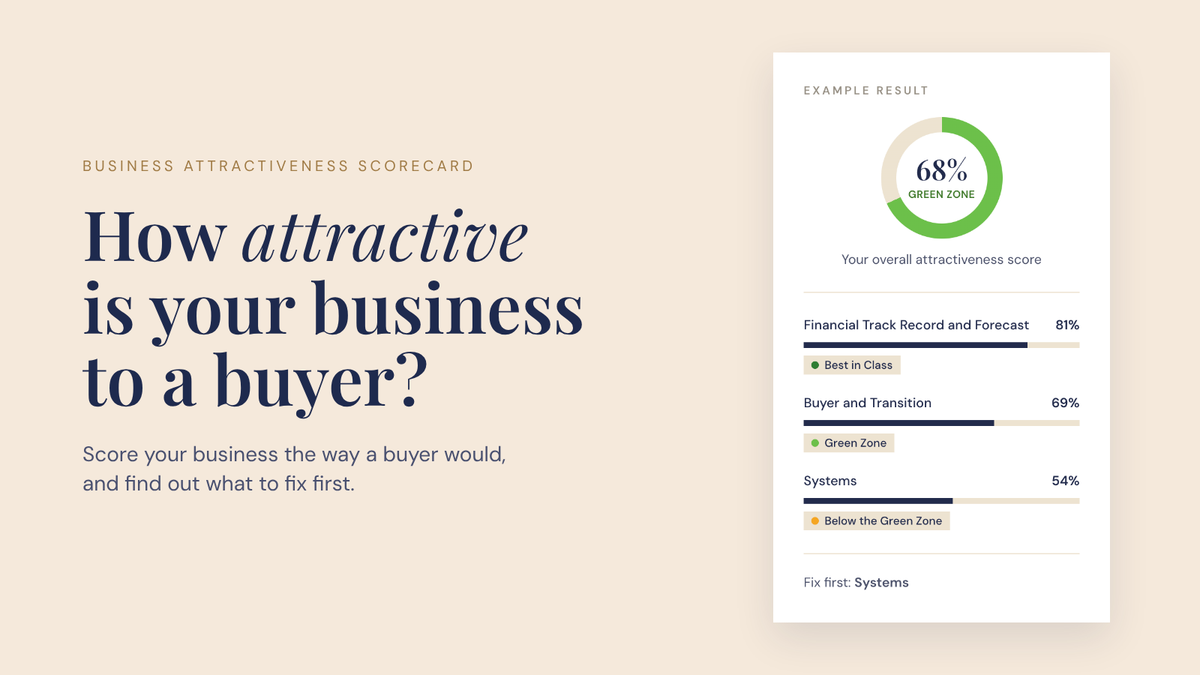
The Business Attractiveness Scorecard shows you how your business looks from the other side of the table. It takes you through the same areas a buyer will examine, from your IP and brand to your systems, team, financials and market position.
There's one rule: score every question as a buyer would see it, not as you see it. No proof means no higher than a 2. If you're unsure, pick the lower number.
It's honest, and it might sting a little. But you'll come away with:
- Your overall attractiveness score
- Your strongest and weakest areas
- A clear starting point for building a more valuable, transferable business
It's free, and you can take it right now: Take the Business Attractiveness Scorecard